Context & problem
Children with cancer face a range of symptoms and complaints that are important to track. At the same time, it can be hard for a child to describe how they feel every single day.
That's why the design challenge was to make symptom tracking more approachable and appealing. Instead of a purely medical interaction, I wanted to develop a concept that feels more like a familiar, trusted moment for the child.
Research & audience
Because of the project's short timeline of 2 weeks, I wasn't able to run extensive interviews or user tests. I did research the target group and the context in which the concept would be used.
Based on this, I created a persona of a child between 6 and 10 years old. This persona helped me make choices from the child's perspective and take age, experience and ease of use into account.
Process & decisions
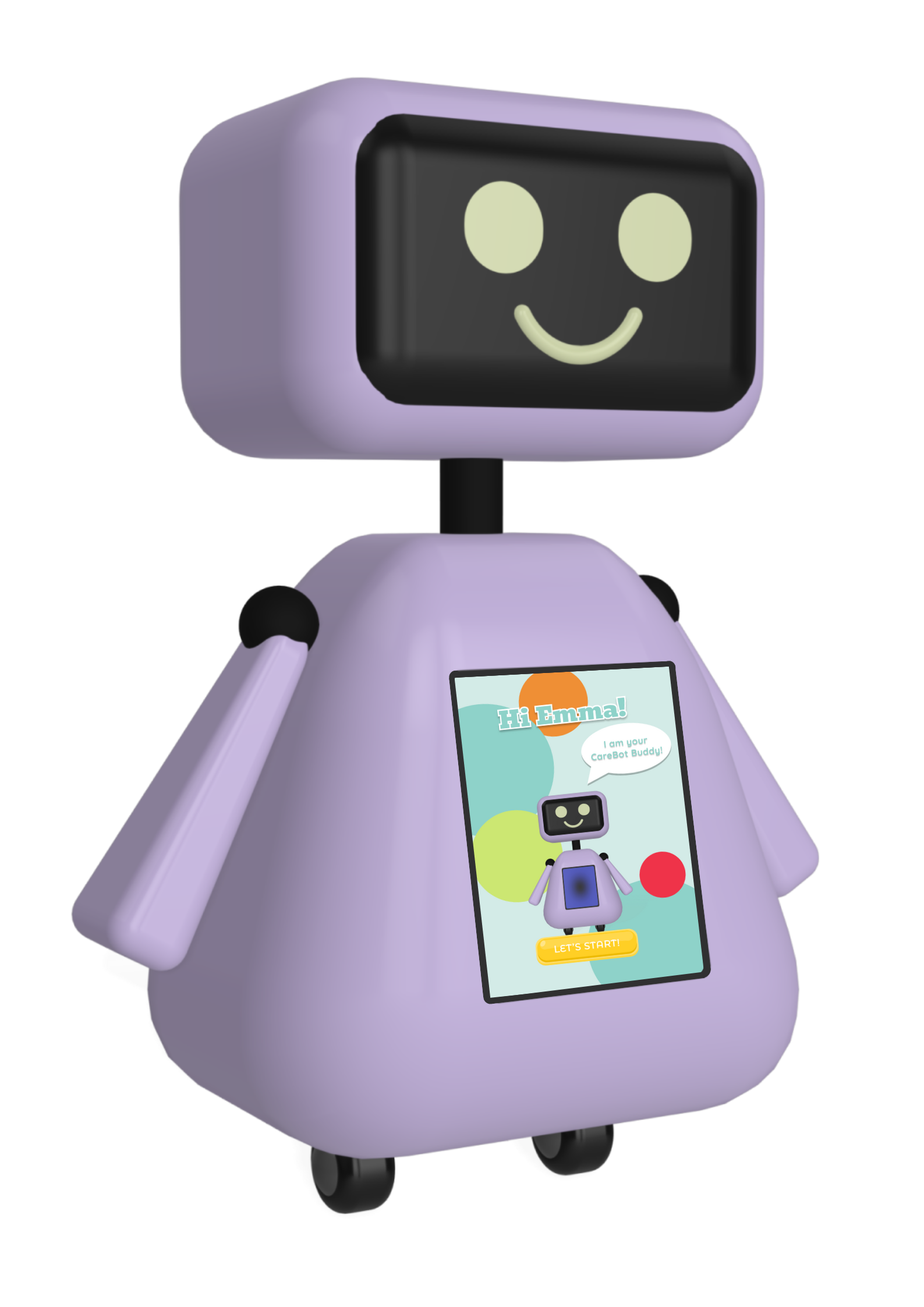
From this research came the concept for CareTech Buddy: an interactive plush robot that acts as a trusted companion by the child's side.
On the screen on its belly, the child can indicate daily how they feel, for example through emojis. By linking this to gamification and a reward system, logging symptoms becomes less clinical and more of an interactive moment.
Alongside the digital interface, I also designed the physical product. I developed the Buddy's appearance as a 3D model and produced a 3D-printed prototype from it.
Within the concept, I also explored what role AI could play. By learning from previous interactions, the Buddy could eventually recognise patterns and offer personal feedback or predictions. This was part of the concept but wasn't actually validated within this short project.
Result
The result is a combination of UX/UI design, gamification and physical design. The digital interface, the interactive Buddy and the reward system together form one concept.
CareTech Buddy aims to make a daily medical routine more approachable and pleasant for the child. At the same time, the information gathered can ultimately contribute to a better picture of how the child is feeling.
The project resulted in a fully worked-out digital concept as well as a physical 3D-printed prototype.
Reflection
The short timeline meant I had to switch quickly between research, concept development, UX/UI and physical design. That made the project intense, but it's exactly what taught me to move quickly from a problem to a concrete, tangible concept.
What I found especially interesting was the combination of digital and physical interaction. The interface doesn't stand on its own here — it's part of a larger product and a complete user experience.